Creative Agency Pricing: Scope, Revisions and Refunds
· 11 min read
Compare what the fee covers - not just the price. A quote for 8 files may exclude extra formats, source files, or paid-ad usage rights. Before paying, get the deliverables, deadlines, revision limits, and extra charges in writing.
Check these points across agencies, freelancers, studios, creators, DIY, and AI tools:
- Total cost: Include production, licensing, add-ons, and your team’s review time.
- Revisions: Define a feedback round, separate error fixes from new requests, and require approval before added charges.
- Process: Confirm who checks product facts, brand rules, and consistency across formats.
- Rights and refunds: Check file access, usage limits, cancellation charges, and remedies for missing or incorrect work.
For Product Campaign Studio, verify the posted $50 first-campaign price, two revision rounds per asset type, and 30-day refund terms against the actual order. The written scope and terms - not the headline offer - set the basis for comparison.
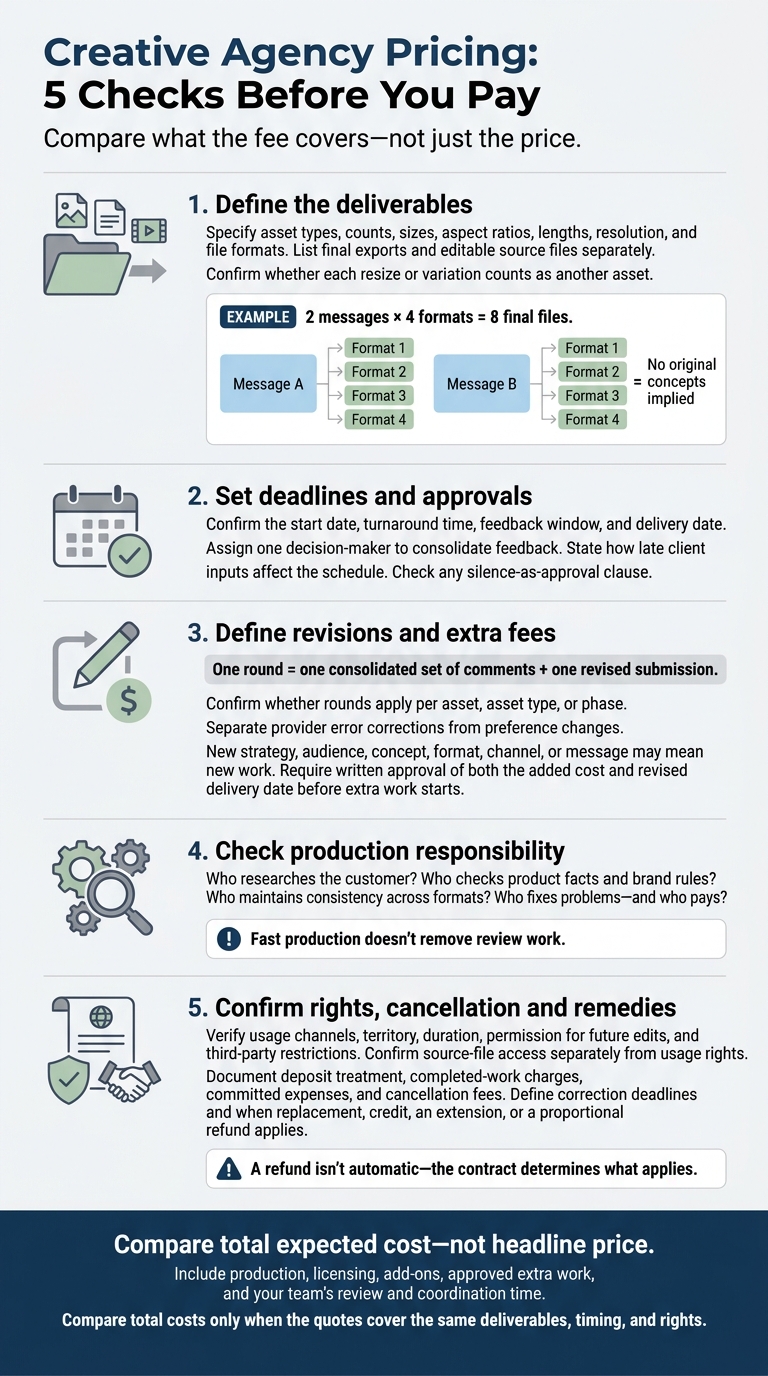
Creative Agency Pricing: 5 Checks Before You Pay
Define Deliverables, Deadlines and Usage Rights
List Asset Counts, Formats and Required Materials
Use the statement of work to spell out exactly what you’ll receive, not just name the service. Include asset types, counts, sizes, aspect ratios, lengths, resolution, and file formats. List final exports and editable source files separately, and clarify whether each resize or variation counts as another asset.
2 messages × 4 formats = 8 final files.
State whether the fee covers research, strategy, creative direction, and spec checks. Also list everything you must supply before production starts: product photos, vector logos, brand guidelines, approved claims, and any required logins or access. If platform specs apply, attach the current Shopify, Amazon, and Meta requirements and identify which version will be used for approval.
Set Deadlines, Approvals and Usage Rights
Set the start date, turnaround time, approval point, feedback window, and delivery date. Assign one decision-maker to collect and send all feedback. Explain whether late inputs pause the schedule and how a restart date gets set. Judge the work against the approved brief, concept, brand guidelines, and specs - not campaign performance. Check any clause that treats silence after the review window as acceptance.
Ownership typically transfers through a written assignment or work-made-for-hire clause, often after final payment. Spell out paid and organic placements, territory, duration, permission for future edits, talent likenesses, music, stock materials, and portfolio use. Confirm when those rights begin and which third-party restrictions still apply after payment. Broader channel use, longer terms, and permission to edit usually increase the fee.
With these terms set, check what each quote charges for revisions and scope changes.
Compare Quotes Line by Line
Get a written total for add-ons, then add the base fee, required add-ons, and approved rush charges. Compare total costs only when the quotes cover the same deliverables, timing, and rights.
Scope item Quote A: Production only Quote B: Full service Creative concept Client-supplied Included (2 directions) Asset count 8 (2 messages × 4 formats) 8 (2 messages × 4 formats) Research/audit Excluded Included Revisions 1 round 2 rounds Editable source files Included Included Turnaround 5 business days 10 business days Total fee $1,150 $1,570 Extra-fee trigger Any change to the brief New creative direction Hypothetical scope details adapted from.
Next, check the revision terms: what counts as a change, and what triggers an extra fee.
sbb-itb-e3697cd
Calculate Revision Costs and Compare Production Options
Separate Revisions From New Work
A revision stays within the signed scope. New work changes the strategy, audience, concept, format, channel, or message.
Request Likely pricing treatment Approval impact What to confirm Edit an approved headline Included within the agreed scope and remaining rounds; otherwise billable May need another approval pass Does approval close this stage to further included edits? Resize an approved 1:1 ad to 4:5 and 9:16 Adaptation fee if those formats were outside the original scope Requires a new export and check cycle Were these formats included in the quoted deliverables? Add headline or image variations Additional asset fee unless already counted Each variation needs review How is a variation counted and priced? Request a new angle or cast New direction; change order May restart concept approval and production Which completed work can still be used? Add five products New deliverables and production fees Adds product checks and approvals What is the added cost per product and format? Correct a product error Provider errors should be corrected without charge; incorrect client inputs may be billable Requires accuracy review Who supplied the incorrect detail?
Define Feedback Rounds and Extra Fees
Define a round as one consolidated set of comments and one revised submission. Specify whether the allowance applies per asset, asset type, or phase, and whether unused rounds expire or roll over.
Keep error fixes separate from preference changes. A wrong product detail shouldn’t use the same round as a color tweak. Set a feedback deadline for each round, and check any silence-as-approval clause. Some contracts use a 5–10 business day window.
For extra work, document the hourly rate, per-asset charge, or fixed fee, along with any estimate or spending cap. Require written approval of both the added cost and the revised delivery date before that work starts.
Compare Total Cost, Effort and Output
Once revision terms are clear, compare the full production model - not just the quote.
Use comparable, current written quotes instead of a category-wide price range. Ask each provider to break out briefing, research, production, adaptations, licensing, corrections, and coordination. Add your team’s review hours and vendor-management time, too. For subscriptions, divide the full cost by the finished assets you expect to use - not the maximum advertised output.
Compare the same deliverables, revision limits, and rights across options. Include coordination costs that the quote may leave to your team.
| Option | Cost structure and range drivers | Speed and effort | Control, output quality, and best use |
|---|---|---|---|
| Photo shoots and studios | Shoot or project fees; styling, talent, and usage rights affect cost | Depends on scheduling; requires product preparation and approvals | Direct control over physical presentation; useful for detailed product and hero imagery |
| Freelancers | Hourly or project fees; specialty, workload, and revisions affect the quote | Depends on availability; you may need to coordinate several specialists | Direct access to the maker; strong specialist work when the portfolio matches the brief |
| Agencies | Project fees or retainers; research, strategy, formats, and account support affect cost | Structured production; confirm how much coordination the agency handles | Can bring several disciplines together; verify who owns cross-format consistency |
| UGC creators and marketplaces | Per-video or per-asset fees, plus usage rights and edits | Varies; plan for casting, filming, and review | Strong creator-led delivery; pre-approve claims and boundaries for concepts and execution |
| DIY | Internal labor, equipment, and software | Depends on team availability; hands-on effort stays internal | Direct control; quality depends on your team’s production skills |
| AI photo, video, or ad tools | Subscriptions or credits | Generation can be fast; finished delivery still needs checking | Specialist tools can produce strong results within one format, such as UGC-style video or ads; check product accuracy and consistency across formats |
Apply the same test to every option: Who researched the customer? Who kept the product accurate across formats? Who maintained one concept? And who fixes problems? Make sure the quote assigns responsibility for research, brand consistency, and corrections.
Fast production doesn’t remove review work. Someone still needs to check product facts, claims, exports, and usage rights. If several vendors or tools are involved, confirm who fixes mismatches - and who pays.
Before you sign, look beyond cost and output to how the team researches, reviews, and corrects the work.
Check the Process Behind the Quote
Once you’ve compared scope and revision terms, ask how the provider will carry out the work.
Ask About Research, Brand Rules and Consistency
Ask how research identifies primary and secondary customers, and where the provider stores approved product descriptions, restricted claims, and brand rules. Check whether the same concept and cast carry across formats - and who fixes mistakes. Good-looking work can still miss the mark if it starts with the wrong customer assumptions. Using separate vendors or single-format tools can also lead to mismatched visuals.
Confirm whether one order covers the whole campaign and how research, coordination, and corrections affect the price and revision allowance. Compare those answers with the provider’s stated process.
How Product Campaign Studio Handles the Work
Product Campaign Studio says its team reviews the materials you supply, then uses campaign goals and casting preferences to build an original AI cast. The client chooses a direction before production across formats begins. The team combines human brand review with automated product-accuracy checks and stores brand guidance for later orders.
The process uses keep/change/skip review steps, with two revision rounds per asset type and corrections for confirmed product errors. Deliverables include full-resolution, final, watermark-free files, alternates, and defined usage rights. Human support is also available. Confirm what materials you need to supply, how many alternates you’ll receive, and how the team handles product errors.
Check Product Campaign Studio Pricing Against Your Order
Posted pricing lists a first campaign at $50, including setup. Product images cost $10 per asset, lifestyle images $19, and Meta ad creative ideas $12. Verify these prices against your order before paying. Video, banner, social, and motion assets have separate rates. Extra-product fees or asset surcharges may also apply.
Ask for a quote that spells out which sizes, alternates, and format changes are included and which cost extra. Check whether approved brand guidance carries into later orders. Usage rights don’t mean ownership or source-file access: request the license terms and any editable-file fees separately. Review cancellation and refund terms separately, too.
Confirm Cancellation and Refund Terms Before Paying
Once you’ve compared scope and revision terms, pin down what happens if the project stops or the work misses the brief. Include cancellation, refund, handoff, and payment terms in the same agreement as the SOW. Resolve any conflicts before you pay.
Check What You Owe After Cancellation
Ask how your deposit counts toward completed work, committed expenses, and any cancellation fee for reserved capacity. For monthly work, notice periods often range from 14 to 30 days.
Use this matrix to compare outcomes at each project stage. A refund isn’t automatic - the contract determines what applies.
| Event | Amount potentially owed | Files delivered | Rights granted | Available remedy |
|---|---|---|---|---|
| Cancel before work | Deposit or stated cancellation charge | Usually none | Usually none | Refund or forfeiture of the deposit, per contract |
| Cancel after research | Completed research, committed expenses, and stated cancellation fee; deposit credited | Research documents and strategy; work in progress if agreed | Limited until full payment | Payment for time spent; client keeps strategy if paid |
| Cancel after production | Completed production, committed expenses, and stated cancellation fee; deposit credited | Paid-for finals and agreed work in progress | Contract-defined license or assignment after payment | Settlement of the final invoice |
| Deliverables missing | Payment for accepted work, subject to contract | Completed files | Rights to paid-for assets as agreed | Correction, replacement, credit, or proportional refund |
| Work matches the brief, but you want a different direction | Agreed fee for completed stage | Final exports | Per contract | Included revision rounds or change order |
Set Remedies for Missing or Incorrect Assets in Writing
Spell out how and when to report missing or incorrect product images, ad frames, and source files. Set a correction deadline and state when replacement, credit, an extension, or a proportional refund applies.
Clarify whether the remedy covers only the affected assets or the whole project, along with usage rights for paid-for assets. Separate provider errors from delays caused by missing client materials or late feedback. Check any automatic-acceptance deadline, too.
Product Campaign Studio states a 30-day refund policy and offers up to two corrections for confirmed product inaccuracies before manual correction or a per-frame refund. Before ordering, verify when those 30 days begin, who qualifies under the current policy, and what exclusions apply.
Use This Prepayment Checklist
Before sending payment, confirm:
- Asset counts and specs, revision rounds, change fees, and correction rules.
- Timelines tied to approvals and client dependencies.
- Usage rights, source files, and file handoff if the project is canceled.
- Deposit, cancellation, and remedy terms.
Compare the total expected cost, including revisions, usage rights, and extra fees. Get legal advice for disputed terms.
FAQs
How can I spot hidden costs in a creative quote?
Confirm what’s included: deliverable counts, file formats, sizes, variants, and revision rounds. Agree on what counts as a revision versus a new direction, and settle scope-change pricing before extra work begins. Check the turnaround time for each asset and whether client delays pause the schedule.
Verify source-file ownership and access, licensing terms, and paid usage rights - especially for creator/UGC footage. Review cancellation and refund terms, including how they apply to deposits, completed work, in-progress assets, and forfeited or missed deliverables.
What if we disagree on whether an edit is new work?
Follow the contract’s definition: revisions stay within the approved creative direction. A different concept, audience, messaging, format/channel, or creative strategy counts as new work, with separate pricing and scheduling.
Use written approvals from each stage as the reference point. After approval, changes either count toward the revision limit or require a change request and a new estimate before work begins.
What proof should I keep when requesting a refund?
Keep the signed contract and initial quote outlining deliverables, revision limits, and termination or kill fees. Save emails and project-platform records that track scope, feedback rounds, change orders, and timestamped approvals.
If the engagement ends, retain work-in-progress and final files, along with records of expenses already paid. This paper trail helps show what both parties agreed to, what was completed and accepted, and whether the project was paused or abandoned under the contract terms.